Typing speed plays a bigger role in daily productivity than many people think. Studies on digital workplace efficiency suggest that small improvements in typing workflow can noticeably reduce time spent on routine computer tasks.
When writing emails, reports, or messages every day, even a few seconds saved per task quickly add up.
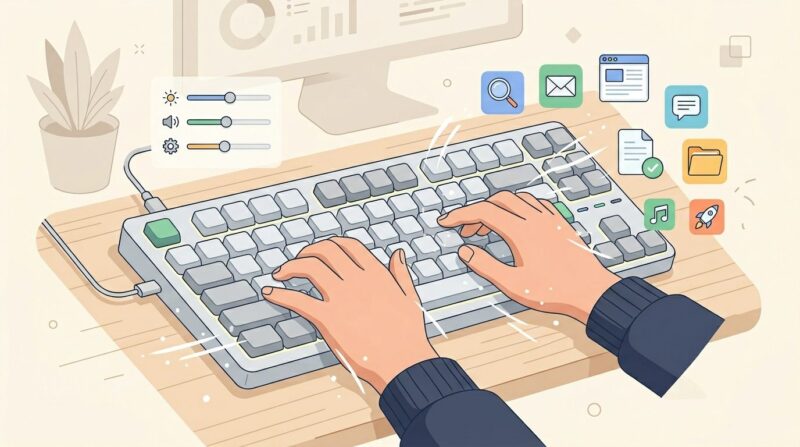
Most users rely on default keyboard settings without realizing how much customization can improve speed and comfort. Adjusting repeat rates, shortcuts, input methods, and layout behavior can remove small delays that slow typing down.
With the right configuration, the keyboard becomes a more responsive tool that supports your natural typing rhythm.
The sections below explain practical keyboard customization settings that can help improve typing speed in everyday work.
Why Default Keyboard Settings Often Slow People Down

Most computers arrive with factory keyboard settings that aim for universal compatibility. While that works for basic tasks, the configuration rarely matches individual typing habits.
Default settings are often designed for safety and simplicity rather than performance. This results in small delays or unnecessary steps that accumulate throughout the day.
Common limitations of default keyboard setups include:
- Delayed key repeat timing, which can slow down navigation and editing tasks
- Unoptimized input methods, especially when switching between languages
- Limited shortcut use, forcing users to rely heavily on the mouse
- Generic layout assumptions, which may not match a user’s typing style
These issues seem minor individually. Over hours of typing, however, they can significantly reduce efficiency.
Adjusting your keyboard environment allows your system to adapt to your habits instead of forcing you to adapt to the device.
Choose the Right Input Method for Your Workflow
For many people, typing efficiency depends heavily on the input method used for text entry. This is especially true when working in multilingual environments or when typing complex characters.
Some input systems offer predictive suggestions, phrase memory, and smart correction tools that significantly reduce typing effort. In practice, these tools allow writers to type fewer keystrokes while producing the same amount of text.
For example, users who work with Chinese input systems often rely on advanced predictive engines. One commonly used option is 搜狗输入法下载 (Sogou Input Method Download), which provides a large dictionary database and intelligent phrase suggestions.
Features like adaptive word prediction and contextual recommendations help reduce repetitive typing and improve accuracy.
Choosing the right input method can affect several aspects of daily typing:
- Speed of character input
- Accuracy of predicted words or phrases
- Ease of switching between languages
- Reduced typing repetition for common expressions
Once a suitable input system is installed, adjusting additional keyboard settings becomes even more effective.
Adjust Key Repeat Rate and Delay
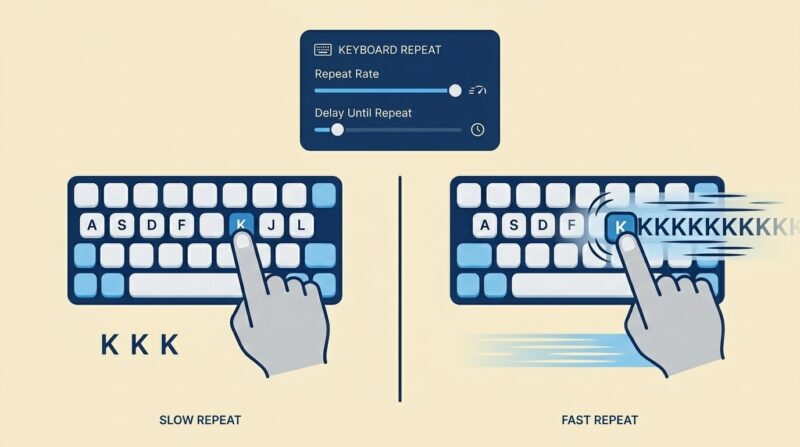
One of the most overlooked keyboard customization settings is the key repeat configuration. This setting determines how quickly a key repeats when it is held down.
The two important parameters are:
- Repeat delay – how long the system waits before repeating a key
- Repeat rate – how quickly the character repeats after the delay
Most operating systems ship with conservative values that prioritize control rather than speed.
Lowering the repeat delay and increasing the repeat rate can make editing text much faster. Cursor movement becomes smoother, and deleting text becomes quicker when holding the backspace key.
Here is a simple comparison of typical configurations:
| Setting | Default Behavior | Optimized Typing Setup |
| Repeat Delay | Slow response before repeating | Short delay for faster editing |
| Repeat Rate | Moderate repeat speed | Faster repeat for navigation |
| Editing Efficiency | Standard | Noticeably improved |
After adjusting these settings, spend a few minutes typing normally to ensure the new configuration feels comfortable rather than overly sensitive.
Customize Keyboard Shortcuts for Frequent Tasks
Keyboard shortcuts remove the need to constantly move your hand between the keyboard and mouse. Over the course of a full workday, this saves a surprising amount of time.
Many users rely only on basic shortcuts such as copy and paste. However, operating systems and applications allow custom shortcut creation for common tasks.
Consider customizing shortcuts for actions such as:
- Opening frequently used applications
- Switching between virtual desktops
- Inserting frequently used phrases or templates
- Launching productivity tools
For example, writers who regularly insert formatted headers or templates can assign shortcut combinations to trigger them instantly.
Over time, customized shortcuts build muscle memory that allows tasks to happen almost automatically.
Modify Layout Settings for Your Typing Style

Keyboard layout configuration is another powerful way to improve typing speed. Standard layouts like QWERTY work well for most users, but many people benefit from small modifications.
Some customization options involve switching to alternative layouts such as Dvorak or Colemak. These layouts are designed to reduce finger movement by placing commonly used letters in easier positions.
However, switching layouts requires retraining muscle memory. For many people, small layout adjustments within the familiar QWERTY structure provide a better balance.
Useful layout-related settings include:
- Enabling language switching shortcuts for bilingual users
- Adjusting modifier key placement if your keyboard allows remapping
- Configuring caps lock replacement, often mapped to control or escape for faster commands
Small layout tweaks like these accumulate into meaningful productivity gains.
Enable Text Expansion for Repetitive Writing
Text expansion tools allow users to type short abbreviations that automatically expand into longer phrases. This is particularly useful for people who write repetitive responses, technical documentation, or structured reports.
Instead of typing a full sentence repeatedly, the system inserts the text automatically when the abbreviation is typed.
Examples of common text expansion uses include:
- Email signatures
- Frequently used customer responses
- Technical instructions
- Repeating addresses or company names
For example, typing a short abbreviation like “addr1” could automatically insert a full address block.
Adjust for Comfortable Typing

Accessibility settings are not only designed for users with disabilities. Many of these features can improve typing comfort and reduce strain during long work sessions.
Several accessibility features worth reviewing include:
- Sticky keys, which allow modifier keys to activate without holding them down
- Filter keys, which ignore accidental repeated keystrokes
- On-screen keyboard overlays, useful when learning shortcut combinations
Another important factor is keyboard feedback. Some systems allow adjustments to key press sound or visual indicators.
Small ergonomic improvements can extend comfortable typing sessions and reduce fatigue, especially for professionals who type several hours per day.
Use Auto Correction Carefully
Auto correction features can dramatically reduce typing errors when configured properly. However, poorly tuned correction systems can also introduce unwanted word replacements.
When adjusting auto correction settings, focus on three main areas:
- Frequently misspelled words that the system should automatically fix
- Common typing errors caused by finger placement
- Words that should never be automatically replaced
Creating a personal dictionary helps maintain control over these corrections.
A well maintained dictionary gradually learns your vocabulary and reduces interruptions during typing. Over time, the correction system becomes more accurate and less intrusive.
Final Thoughts
Faster typing often comes from smarter keyboard configuration rather than simply typing more. Small adjustments such as shortcut customization, improved input methods, and optimized key repeat settings can significantly improve daily workflow.
Once these settings match your typing habits, writing becomes smoother and more efficient. The keyboard begins to support your pace instead of slowing it down, making everyday digital tasks easier to complete.