
A client receives a carefully researched article, pastes it into an AI detector, and sends back an alarming score. For a freelancer or small business owner, a single percentage can suddenly turn a normal content project into a debate about authorship.
The strongest response is a small body of evidence: an AI-detection report, document version history, research notes, source records, and earlier drafts. No detector can conclusively certify who wrote a paragraph.
Independent research shows that leading commercial tools can perform well, while accuracy still varies with the detector, text length, editing, and writing style.
University of Chicago Booth research found major differences among tools, while the NIST GenAI evaluation program continues examining the gap between generation and detection.
Why an AI detector score is evidence, not proof

AI detectors look for statistical and linguistic patterns associated with machine-generated writing. A score is therefore a prediction rather than a digital fingerprint left behind by an AI model.
False positives remain possible. Turnitin’s own guidance says its lower AI-writing range has a higher incidence of false positives, which is why results below 20 percent receive special treatment in its reporting.
Research from the University of Chicago also found far stronger performance from several commercial detectors than from open-source alternatives, but results still differed by tool and passage length.
The practical lesson is simple: avoid treating “2% AI” or “78% human” as courtroom-style proof. A detector report becomes far more persuasive when it agrees with a visible writing process.
Short, highly structured copy can be awkward for automated classification. Product descriptions, legal disclaimers, service-page introductions, FAQs, and technical instructions often use predictable language because clarity leaves fewer sensible ways to phrase the same point. A human writer can produce prose that looks statistically ordinary.
Pensacola businesses have good reasons to document authorship

Greater Pensacola has economic activity spanning professional services, healthcare, hospitality, manufacturing, education, finance, and related fields. The FloridaWest Economic Development Alliance highlights a regional economy combining major employers with professional and entrepreneurial activity.
Content moving through that mix can include website pages, proposals, newsletters, tourism copy, recruiting material, client reports, and thought-leadership articles.
For a local freelancer, an authorship dispute can affect payment or repeat work. For a small agency, it can affect a client relationship. An in-house marketer may face the same problem when a manager assumes polished copy came from a chatbot.
Good recordkeeping turns the conversation from “trust me” into “here is how the work was produced.”
Build an authorship record while writing

The easiest evidence is created during the job, long before anyone asks for it.
Keep document history turned on
Google Docs can show earlier states of a file through Google Docs version history. Microsoft Word users can preserve revisions with Word Track Changes.
A document that grows from an outline to rough paragraphs, then receives edits, reordered sections, added sources, and rewritten sentences gives a client something a detector score cannot provide: a visible development trail.
Version history is especially useful for longer assignments. A 1,200-word article appearing gradually through multiple revisions presents a clearer authorship record than a finished block pasted into an empty document.
Save the research trail
Keep the client brief, interview notes, source list, keyword research, handwritten notes, factual checks, and relevant correspondence connected to the assignment.
Imagine a freelance writer preparing a service page for a Pensacola roofing company. Notes from a phone call about roof types, storm concerns, warranty language, and service areas can sit beside the draft history. A client reviewing both can see where specific details entered the copy.
Source records also help separate authorship from originality. AI detection and plagiarism detection answer different questions. Human writers can copy material, while machine-generated prose can contain wording that appears original.
Run more than one detector

A second detector gives useful context when a client relies heavily on a score. For an additional no-cost check, ZeroGPT offers an AI detector free of charge that can provide another result to compare with the client’s preferred tool.
Agreement between reputable systems can strengthen a report, while disagreement should discourage a firm conclusion.
Pangram performed strongly in independent University of Chicago testing, and Pangram’s current detector provides document-level results and highlighted analysis.
GPTZero reports high accuracy in its published benchmarking, while Copyleaks publishes performance figures on its AI Detector page. Vendor accuracy figures should be treated as vendor claims unless independently replicated.
For client work, scan the final version rather than a half-edited draft. Save the report date, tool name, result, and exact file tested.
A simple proof package clients can review

A freelancer does not need a forensic dossier. A compact package usually gives enough context:
- the final file submitted to the client;
- a screenshot or shareable view of document history;
- an outline or early draft;
- source notes or interview notes tied to the assignment;
- reports from one or two reputable AI detectors;
- a short disclosure describing any permitted AI assistance.
Disclosure matters when a contract distinguishes between human writing and AI-assisted editing.
Spell-checking, transcription, grammar suggestions, research assistance, and full text generation may fall under very different client policies. Record what was used instead of trying to force every project into a binary label.
Small businesses can make the same process part of vendor onboarding. A one-page content policy can define acceptable tools, required disclosure, ownership of drafts, and what evidence a writer should retain.
Do not rewrite good copy merely to beat a detector
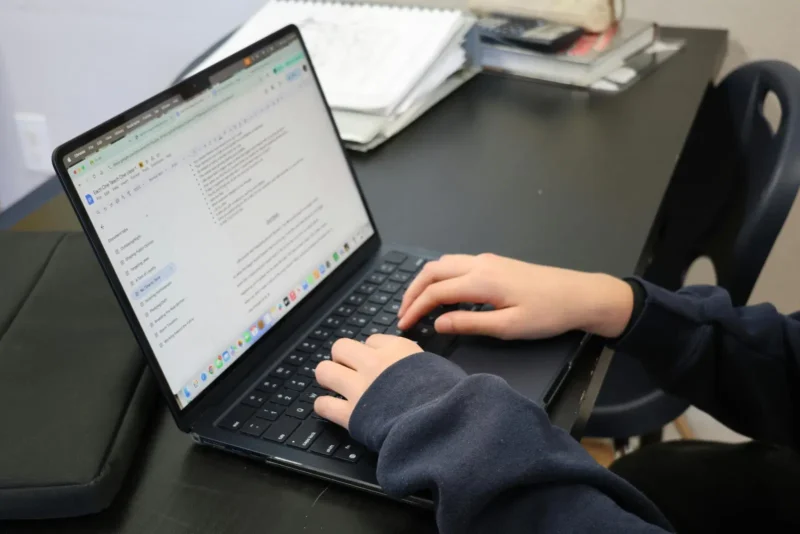
Chasing a lower AI score can damage strong writing. Writers sometimes add awkward phrasing, unnecessary slang, random sentence fragments, or deliberate errors because they believe irregular prose will look more human.
A better response to a suspicious score is investigation. Check another detector. Review flagged passages. Compare them with earlier drafts. Look at version history. Consider whether the subject naturally requires standardized or repetitive language.
Current Google guidance also gives small-business owners an important reality check. Google’s generative AI guidance focuses on useful, original content and warns against large-scale generation that adds little value. Google does not present a third-party “human score” as an SEO ranking requirement.
For a Pensacola business trying to rank a service page or publish a useful local guide, quality, accuracy, firsthand value, and clear sourcing deserve greater attention than forcing every detector to return zero AI probability.
Human authorship is strongest when the process is visible
AI detection can support a freelancer’s case, especially when reputable tools agree. A stronger standard combines detection with provenance: drafts, timestamps, revision history, research notes, and transparent disclosure.
A Pensacola freelancer who keeps that evidence from the start can answer an authorship challenge quickly. A small business can use the same approach to evaluate outside writers without turning one algorithmic score into a verdict.
The goal is a credible record of how the work came together. A human writing process leaves traces, and preserving those traces is often the most convincing evidence available.